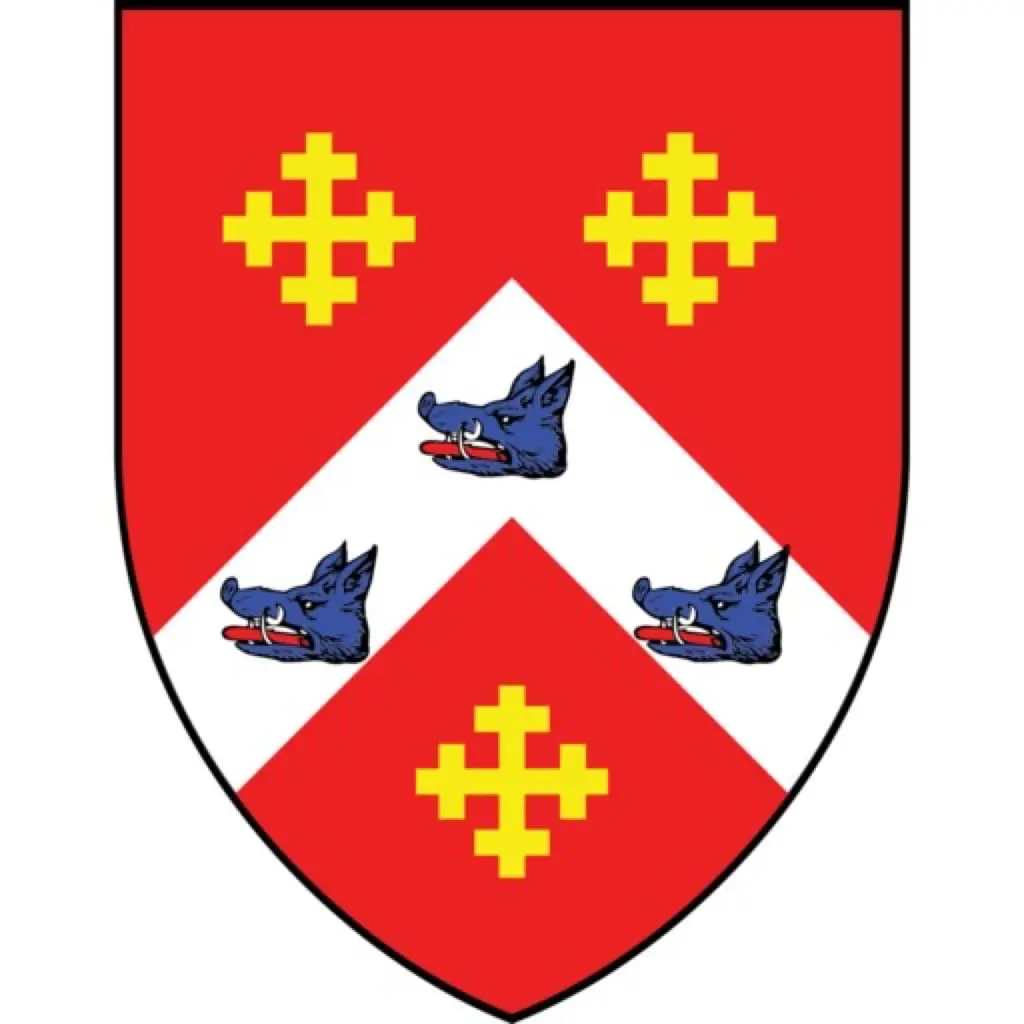
From the eighteenth century the Anglo-Irish families of
Tenison, King-Tenison and Kingston inhabited the region of North
Roscommon, Ireland. For a long period they occupied Castle Tenison,
later known as Kilronan Castle. Today the castle is derelict. What
follows is taken from an account written by an unknown writer, who was
presumably a native of
Kilronan Parish.
Towards the end of the eighteenth century what later became
known as Castle Tenison, and a considerable estate, belonged to Sir
Thomas Dundas, Baronet. This was the property which later passed into
the hands of the Tenisons and ultimately the Earl of Kingston. The
Tenisons were English, as the name implies, and are traceable back as
having resided in Oxfordshire in the Reign of Edward 1st. The name was
then "Tunesende". We know that Richard Tenison, who was later the Bishop
of Meath, was born at Carrick Fergus in 1640. His second son, Richard,
represented Dunleer in the parliament of 1715. It would appear that he
purchased considerable estates in counties Leitrim and Roscommon, which
formerly belonged to Sir Thomas Dundas - among them the lands of
Kilronan. He died in 1726 leaving the son, William, who in 1746 was
Lieutenant Colonel of the 35th Regiment of Foot, which had been raised
in Ireland to oppose the expected invasion in support of the Pretender
(Bonnie Prince Charlie). You may be aware that an Irish Brigade in the
service of France fought with outstanding bravery in Scotland on behalf
of the Pretender. They were finally cut to pieces by overwhelming
forces. In 1728 the widow of Richard Tenison married Dr. Delany, a
friend of Swift who presided at Delville House, Glasnevin.
The third son of Richard Tenison of Meath was Captain
Thomas Tenison. He succeeded on the death of his brother Richard to the
Leitrim and Roscommon Estates and he died in 1763 leaving a son, Thomas
Junior. He had a son, Thomas, who represented the Borough of Boyle in
the parliament of 1792 and was afterwards Lieutenant Colonel of the
Roscommon Militia. In 1803 he married Lady Frances King, youngest
daughter of the 1st Earl of Kingston. Arthur Young in August 1776 stayed
some days with the Mahons in Strokestown and then proceeded to Boyle,
but he makes no mention of having visited Castle Tenison. He mentioned
that Lord Tenison was then at Spaw.
At the Assizes in Roscommon in 1793 a man named McDiarmod
was indicted for having on 21st May, feloniously with several persons
unknown, broken open the House of Thomas Tenison Esquire and thereout
stole several articles of plate, ware etc. To this he pleaded not
guilty. At this time, if the value of the property stolen exceeded a
certain small sum, the penalty was death. The prisoner was defended by
councellors John
Geoghegan and Owen McDermott. Chief Baron Barry Telverton charged
the jury and they retired to consider their verdict at 10 pm. As they
did not agree the court adjourned until the following morning. In the
meantime they were accommodated for the night in a dormitory room on
straw mattresses. When the court re-assembled the following morning an
agreement was still unlikely, so they were informed by the court that
dung carts would be ready at 3 clock to cart them to the bounds of the
county, 15 miles off, there to be discharged. The jurors were drawn from
all over the county. The weather was cold and cheerless and the majority
were determined to ensure their coming to a unanimous decision. The
Foreman accordingly insisted that those differing from him, four in
number, should give way and find the prisoner guilty. They with equal
determination resisted all persuasion. A hand to hand fight ensue.
Fortunately the only fire arms in the room were the fire irons, but even
those were too freely used. The uproar reached the ears of the judge:
the halberdmen rushed upstairs broke open the door and with the aid of
the military succeeded in dragging the jurors, battered and bleeding
into the court. Each party swore that they would have the other's lives.
His Lordship then administered a severe lecture to them and they were
led down to the dung casts, 3 in number, which were ready to receive
them. On they moved attended by the sub-sheriff on horseback and by a
troop of the 14th. Light Dragoons. As the jury were leaving the town
those that had been for acquitting the prisoner consented to find him
guilty of stealing property to a value of four and ninepence, to which
the others assented. The compromise came too late as the judge had left
town and so they must travel on for hours before those awkward vehicles
could reach him: for the rough roads up hill and down dale were then
impossible to wheel carriages. The wheels revolving on wooden axles,
which were never oiled, made a detestable half screaming half whistling
sound.
Of the marriage of Thomas Tenison with Lady Frances King in 1803 there
were two sons Thomas, who died at Florence in 1843, and Edward King
Tenison, who assumed the additional name of King from his mother. As
landlords went he must have been considered somewhat liberal. On 9th November 1824 a religious controversy took place in
the Grand Jury Room of the new Court house in Carrick-on-Shannon between
3 Catholic clergymen, Rev. Doctor McKeon, Rev. George Brown and Rev.
Michael O'Beirne and 3 Protestant clergymen, Archdeacon Digby, Rev.
George Hamilton and Rev. William Bushe There was a contest for the
chair, Rev. Dr. McKeon proposed Col. Edward Tenison of Kilronan but on a
draw from the hat John Reynolds Peaton was appointed. Rev. George Brown
later became Bishop of Elphin and in August 1847 was mainly instrumental
in having the renegade, William Keogh returned as a member of parliament
for Athlone. Keogh was later made a high Court Judge where he earned the
odium of the people of Ireland. This was a forerunner to the famous
discussion between Rev. Richard Pope and Rev. Thomas Maguire in 1827 in
the Dublin Institute, over which Daniel O'Connell, among others,
presided. Rev. Thomas Maguire later became Parish Priest at Drumkeeran.
It was said of him "His were the best horses and the best hounds, the
best dogs and the best guns in the hunting field, in the pulpit and at
the altar he held the foremost place."
At the Summer Assizes of 1847 in Carrick-on-Shannon his housekeeper and
her husband were indicted for his murder.
They were defended by Counsellor Concannon and acquitted.
The discussion in Carrick-on-Shannon was very orderly. Strict rules were
agreed on and the public were only admitted by ticket. At the conclusion
all the participants shook hands and neither side appeared to have
convinced the other. This
was in contrast to some of the other scenes at religious controversies
in other parts of the Country.
In Dingle in 1650 there was a serious clash between the Protestant
rector Rev. Mr. Lewis and Rev. Dr. Eugene O'Sullivan.
In the end large numbers of police and army had to be called in.
On 26th November 1833 Edward King-Tenison, Capt. In the 13th Dragoons
and Lieutenant of the County of Roscommon, married Lady Louisa Anson
daughter of the 1st Earl of Lichfield.
She brought with her a substantial dowry. She was highly educated was
deeply interested in history, archaeology and was pioneer in
photography. Edward King Tenison had been elected a life member of the
Royal Irish Academy on 12th. January, 1846 but it was not
customary then to elect a lady to membership. The only exception was
Maria Edgeworth. At the time of their marriage Kilronan Castle was known
as Castle Tenison.
It was built in the early 19th Century and replaced a house near
the site of the present out-offices. The entrance to the earlier house
was by the short avenue later used as the farm yard entrance.
The new building was of 3
stories, 3 bay symetrical castellated block, with slender corner turrets
or minarets; the rooms were well proportioned and there was delicate fan
vaulting plaster-work on the stairs and landing. Isaac Weld visited the
place in the late 1820's and referred to the castle as a spacious and
costly modern built edifice of 3 stories in height, in form nearly
square with a round minaret tower at each angle; the whole embattled at
the summit. This then was
the castle or mansion to which Lady Louisa came to make her home.
In those days the castle and demense were self-contained and self
sufficient. There was a piped water supply by gravity from the mountain
side. Sheep and cattle were slaughtered and they had a supply of
ice all the year round. The
icehouse was an architectural and engineering masterpiece - stone on the
outside then a brick core suspended by bridging from the stone walls. When the lake was frozen the farm carts were used to convey
the ice to the ice house and it would be tipped in. There was a subterranean tunnel from the direction of the
garden into the basement.
All supplies and fuel were brought in through the tunnel.
The staff and any of the tenantry who had a complaint had to use
the tunnel and woe betide any person who dare to call to the front door.
It was not until the 1880's when her daughter Florence had married the 8th.
Earl of Kingston that the baronial tower and battlemented part of the
castle were added.
As soon as she was married Lady Louisa went about visiting all the
ancient and ecclesiastical ruins in the countryside.
She found cattle and donkeys wandering in and out of the old church
of Kilronan and she was instrumental in cleaning up the place and having
a protective wall erected around the ancient building and graveyard.
She likewise went to a lot of expense in doing similar work at
Fenagh Abbey. She was also instrumental in having the Book of Fenagh
published.
There is a tradition that some of the Tenisons fought in the Peninsula
and Waterloo. As a student
I remember being up on the tower of the castle.
From it I could see plantations of trees planted to scale
representing the armies as they faced one another on the morning of
Waterloo. When I was a schoolboy there was an old lady named Mrs. Hill
living at Cloonman, Carrick-on-Shannon who used to say that she made a
habit, or death shroud, for a soldier who fought at Waterloo.
Mrs. Hill was a dressmaker who was reared close to Kilronan.
An old soldier who had fought at Waterloo was found dead in
wretched conditions near Keadue.
Edward King-Tenison on hearing this undertook to have the man buried; so
Mrs. Hill was asked to make the habit.
Some years ago I purchased from the Countess of Kingston the entire
estate map for l847 of Edward King-Tenison. They are bound in
elephant folio and each holding is coloured and the name of the tenant
or occupier given.
The Cavan property included a holding of
93 acres in the townland of Cullies occupied by Nathaniel
Montgomery as tenant. This holding was later purchased by the Catholic
Bishop of Kilmore and the residence on the holding has been the
episcopal residence ever since.
It was also on this holding St. Patrick's Diocesan College was built.
The County Dublin estate comprised 11 townlands: Naul, Hynestown,
Cabinhill, Loughmain, Flakestown, Rath Little, Nutstown, Wyestown,
Knockaneek, Cornstown, Lecklinstown, in the Parishes of Naul and
Ballymadun. It is difficult to visualise what the value of the property
could be today.
In the townland of Keadue East Robert Daly has a holding of 9a.3r.20p;
John Daly 6a.lr.25p and Patrick Daly 7a.20p. It was from this townland
that the forebears of the present Bishop of Ardagh, His Lordship Dr.
Cathal Daly originated. In August 1776 Arthur Young visited Boyle but
Lord Kingston was at Spaw. Arthur Young said "the lands about Kingston
are very fine, rich, dry, yellow sandy loam, the finest soil I have seen
in Ireland".
The estates consisted of:
Co. Roscommon
-
8517 a.
Co. Leitrim
-
2592 a.
Co. Galway
-
591 a.
Co. Cavan.
-
569 a.
Co. Dublin
-
2732 a.
Co. Westmeath
-
339 a.
The late Sir Thomas Stafford of Rockingham was born and raised on the
family farm at Portobello in Croghan - Elphin District.
I note from the estate maps that the Staffords also had an outlying
farm of 143 a. at Creeve, Parish of Shankhill, as tenants to Edward
King-Tenison.
The late Frank Doherty, who died about 5 years ago at an advanced age
and who had been lamp boy in Kilronan Castle, showed me two large
photograph albums which belonged to Lady Louisa Tenison. The photographs
were almost all taken by Lady Louisa and are dated 1860 to about 1864. I
took copies of 2. They are of Bartley Harrington, letter carrier - the
name applied to a Post Man up to the early part of the present century.
Bartley lived with his wife, Honoria, in a one room thatched dwelling on
a site now occupied by Sean Gibbons in the village of Leitrim. For
upwards of 30 years he walked with the post to Ballyfarnon. He had a
post-bag, walking stick, umbrella and a bugle. He kept to the main road
through Drumboylan and Keadue and if he had a letter for a person he
blew his bugle in advance and the person or neighbour would meet him on
the road and collect it. Bartley used to walk through the King-Tenison
demesne and invariably was given tea or a meal at the castle. He traversed the same route on the return journey.
Frank Doherty's father was Gate Keeper at the Keadue entrance and
he lived with his family in that unique gate lodge built with rockery
stones and which had a flat lead roof in those days.
The lady receiving the letter in the photograph was Miss Florence
King-Tenison, daughter of Edward and Lady Louisa Tenison and who married
the 8th Earl of Kingston. Frank Doherty did not remember Bartley
Harrington, though he was born in the 1870's. He often heard is father
speak of him and as the lamp boy he often saw the photographs in the
library. Bartley Harrington died in the workhouse at Carrick-on-Shannon on 1st. May l884 described as a
letter carrier aged 80 yrs. His wife Honoria predeceased him on 21st
October 1882.
In these days letters arrived in Carrick-on-Shannon from Dublin
by Bianconnie Coach at 3.27 a.m.
At 4.30 the post left Carrick for Leitrim, Keadue, Ballyfarnon,
Dromahaire, Drumshanbo, Dowra, Drumkeeran, Killargue and Manorhamilton.
The coach stopped at Church's Hotel and within 5 minutes 4 or 6 fresh
horses already harnessed would replace the other horses. The most famous
coachman employed by Bianconnie was McCloskey on the Sligo-Longford
stage. The story is told that a passenger in the coach began to eat
McCloskey's lunch - McCloskey in a voice that could be heard said to the
footman, "There is enough poison in that food to kill all the rats that
were eating the oats in Longford", whereupon the passenger became
violently ill. The passenger was McTiernan whose family came from
Mountallen and later from Heapstown.
The album shows the Tenison family and their friends in various
settings. Garden parties show such visitors as O'Conor Don, Wills
Sandford, La Touche, Gething, King-Harman and Anson.
The ladies wore voluminous dresses and the men all had tall silk
hats and morning suits. The
lawns and flower beds were beautifully manicured and maintained
It was the custom to have one of the military bands from Boyle or
Sligo to play during the party.
As you descend towards the lake there was a magnificent cut stone band
stand with 3 flights of steps. The steps are now in front of Arigna
Church.
There are photographs also of the indoor staff showing Diaz the butler,
his wife, Mary, the Taylor,
the dressmaker, the carpenter, the milkman the rabbit trapper and game
keeper. Also numerous photographs of ancient buildings including
Kilronan Old Church, Fenagh Abbey, Ballintubber Abbey. Diaz lived to be
a very great age and his wife lived until October l934 when she died at
the age of 102. I had long conversations with her niece, Miss Lavell,
who lived in the old gate 1odge and died a few years ago having almost
reached 100 years.
She said that in early l850 the Tenisons were staying with the
British Ambassador in Madrid and there met Diaz. who was one of the
staff.
He had deserted from the Spanish Army and could not leave the
compound. They took him back to Kilronan as Butler.
Some years later Lady Louisa and family were cruising in a sloop
off the west Coast of Ireland and they put into Newport and stayed some
days in Newport House as the guests of Sir Richard Q'Donnnell.
There Diaz met his future wife Mary Lavell of Achill Island who
was one of the staff of the house.
The next event of note in
the Tenison family was on the occasion of the laying of the foundation
stone on l5th August 1860 of the Church of the Nativity of Our Lady in
Keadue when Colonel Tenison contributed £100.
Dean Kelly told me that as the foundation stone was laid the
Colonel planked down the cheque on the stone. The family were also
instrumental in securing donations from the Duke of Norfo1k and other
acquaintances.
An important event in the Tenison family occurred on 22nd January 1872
when Florence, daughter and co-heir of Colonel Tenison, married the 8th
Earl of Kingston, a 2nd cousin once removed. The Tenisons did not
approve of the marriage. They were on a grand tour of the Continent when
the daughter decided on marriage. She is photographed receiving a letter
from Bartley Harrington at the old garden gate.
She had a limp. Her husband was known as the Cuckoo Earl and was not
generally received into the houses of the gentry.
By this time he had dissipated his inheritance and was now about to
embark on dissipating the Tenison inheritance.
I must now go back over 200 years to the first King of note in the
Kingston family. Sir John was conspicuous in extending the English Law
and Royal authority over Ireland in the time of Elizabeth and was
rewarded by a lease of the Abbey of Boyle.
He exerted himself further under James Ist. and was rewarded with grants
of large estates in Down, Meath, Westmeath, Dublin South and Kildare and
a reversionary of the Abbey of Boyle and its possessions, as well as
those of the Monasteries of Cong, Ballintubber and Ballinasmall.
Subsequently he received further large grants of lands in various other
Counties including most of the remaining lands and appurtenances
belonging to the Abbey of Boyle. He died in 1636 and was succeeded by
his eldest son Sir Robert King. His 4th son, Edward, was a Fellow of
Christ Church Cambridge. He was drowned in August 1637 on a passage from
Chester to Dublin. He was a close friend of Milton who wrote Lycidas in
his memory. In 1642 Sir Robert distinguished himself at the battle of
Ballintubber and is referred to in Sir John Borlase's History of the
Irish Rebellion. His son John, an active Cromwellian, was made Baron
Kingston by Charles II on 4th September 1660. He married Catherine,
daughter of Sir William Fenton and Margaret Fitzgibbon, sister of the
White Knight.
By this marriage the Kingstons acquired Mitchelstown and the
adjoining estates.
The Kings had the luck of backing the winner except during the short
reign of James II when they were disinherited.
They supported William III and were duly restored and further
rewarded. The name King
occurs monotonously as one or both representatives of the Borough of
Boyle and Roscommon in their early formation. There were 5 successive
Baronets in the family and on 25th August 1768 Edward, the 5th.
Baronet was created Earl of Kingston. He was
married to Jane an illegitimate daughter of Thos. Caufield Donamon.
From that date his eldest son Robert bore the courtesy title of Lord
Kingsborough. In 1769 he married Caroline Fitzgerald of
Mount Offaly, Co. Kildare. She had one brother who died unmarried
but who had an illegitimate son , Henry Gerald Fitzgerald. Lady
Kingsborough took her nephew Henry Gerald to live with her and her
family at Kingstone Lodge, Boyle, now the dilapidated military barracks.
There he was reared and brought up as one of her children. They were
George, afterward 3rd Earl of Kingston, Robert Edward, afterwards Lord
Lorton and 3 daughters, one of them was Hon. Mary King. To provide for
their education the family spent a great part of the year in London.
The Hon. Mary was a beauty with a very pleasing expression. Henry Gerald
Fitzgerald, through the influence of Lord Kingston and Viscount
Kingsborough obtained a Commission in the army and soon rose to the rank
of Colonel. Although he was married he induced the Hon. Mary King, then
only 18 years, to leave her father's house and elope with him. She left
a note saying it was her intention to drown herself in the Thames. Her
bonnet and shawl were found on the bank but though the river was dragged
the body was not found. Her family believed she had committed suicide.
Lord Kingsborough was not convinced and he had advertisements
published in the London journals of the day seeking information. Colonel
Fitzgerald effected to join the search. Eventually a maidservant in a
house in Kensington informed lady Kingsborough that a young girl
matching the description given was staying in the house with a young
man. The game of deception was now up and Colonel Robert Edward King set
a challenge to Col. Fitzgerald. The following morning they met near the
magazine in Hyde Park. Seven shots were exchanged before they separated
when Colonel Fitzgerald's ammunition became exhausted. The following day
the parties were again to meet and in the same place but before the
appointed time both were put under arrest by the police. The young lady
was now conveyed to Kingston Lodge in Boyle and later to Mitchlestown
Castle. Col. Fitzgerald had bribed one of the maidservants who had
accompanied Lady Mary to Ireland and got the most accurate information
of the young lady. Disguising himself he crossed over to Ireland and put
up at a hotel in Mitchlestown with the object of rescuing her. Lord
Kingsborough was informed of the danger to his daughter. In the meantime
Col. Fitzgerald left for Kilworth. Lord Kingsborough and his son Col.
King followed him and they arrived just as he had retired to his room
for the night. They smashed open the door. Col. King rushed at Col.
Fitzgerald as he lay in bed. He begged for mercy. They ran him through
with their swords and left him a mangled corpse. Col. King was
immediately arrested and at the ensuing assizes in County Cork tried
before Sergeant Stanley and acquitted of wilful murder. Lord
Kingsborough elected to be tried by his peers. He was brought before the
Irish House of Lords and acquitted of wilful murder. It is not known
what became of the Hon.
Mary - whether this was her only elopement.
Lord Kingsborough later became the 2nd. Earl of Kingstown.
His eldest son George became 3rd. Earl; his eldest son
Edward, Viscount Kingsborough born 1795 died unmarried in 1837. He was
the author of a celebrated work "The Antiquities of
Mexico". There was a very fine copy in mint condition in 3 volumes
in Rockingham. It was salvaged before the fire and no doubt is in St.
Catherine's Leixlip, the home of Sir. Cecil Stafford King Harman. It has
very important coloured plates and I would imagine is worth up to £5,000
or £6,000.
George, Viscount Kingsbborough, later 3rd. Earl of Kingston,
was born in 1771. Prior to the outbreak of the Insurrection of 1778 he
was quartered with his regiment in Wexford and had engaged in the
hanging, burning, flogging, shooting and exterminating campaign then in
progress. At the fall of Wexford he was captured with other officers by
the insurgents. Edward Hay, in his History of the Insurrection says
"From the great heat and violence of the people against Lord
Kingsborough in consequence of reports of his cruelty and exertions in
flogging and other modes previously practised for quieting the people,
different parties from town and country frequently proceeded to the
house where he was confined with the intention of putting him to death
but the guards always refused to give him out to them without an Order".
The treatment of Viscount Kingston by the insurgents is in marked
contrast to that meeted out to the insurgents by the army and yeomanry.
The 4th, 5th, 6th. and 7th Earls of Kingston were not
distinguished in any way. They resided for the most part in Mitchelstown
Castle and Boyle. Quite a few of them squandered their inheritances but
then they or their sons would marry an heiress and their fortunes would
bloom again. As I have mentioned, Sir John King married Catherine
daughter of
Sir William Fenton and thereby acquired the Mitchelstown property.
There had been a mansion or castle near the town in which the Kingstons
resided when not in Boyle.
In l823 the 3rd Earl, who I have related was captured by the insurgents
in Wexford, commissioned James and George Pain to build a castle on the
old site at Mitchelstown, which would be bigger than any other house in
Ireland. The castle took two years to build and cost £1000,000. It was
one of finest Gothic revival castles in Ireland. It was an enormous
pile.
The Earl entertained in Royal fashion and there were sometimes as
many as 100 people staying there. All were amazed by the splendour, by
the display of plate and army of servants. One of the under cooks was a
young man named Claridge who later founded the hotel in London of that
name.
Robert the 4th Earl suffered a financial crash in 1844.
The Earl and his house party closed the doors of the castle against
the bailiffs and stood firm for a fortnight; then the creditors took
possession and most of the estate was sold up.
Both the 3rd and 4th Earls went mad. Eventually the castle and the
reduced estate was inherited by Anna, widow of the 5th
Earl. She married in 1873 Williain Webber. He was the owner of
an estate in Skreen, Co. Sligo. Elizabeth Bowen, the writer,
described a garden party at the castle on 5th August 1914 which was
its swan song "The food was rather poor and there were discordant notes
from the band on the lawn. During the 19th Century the rents from the
estate brought in £30,000 a year. During the civil war the castle was
occupied by the Republican forces under Gen. Sean Moylan. When they
retreated the castle was burned. Some of the cut stone was bought by the
monks of Mount Melleray and the rest was broken up for road making. The
only building that I could see in Mitchelstown associated with the
family is the cut stone building in the centre of the town now occupied
by the Mitchelstown Co-Op. Society and which was probably a market house
or estate office. On the facade is the crest of the Kingstons (two
raised fingers and thumb).
In 1872 when Florence King Tenison married Henry 8th Earl of Kingston
the Tenison property brought in about £20.000 a year. The Earl had very
expensive tastes and in the 1880s he embarked on the building of
a massive Gothic Revival Castle up against the older building. The
new part is of two storeys, irregular with a large baronial tower,
battlemented gates joined to the building by a corridor with rather
pleasant stained glass windows. I remember two tradesmen from
Carrick-on-Shannon who worked on the building; Dennis Cassidy a
plasterer and Tom Hayden a stone mason. 'i'he drawing room was the only
well-proportioned room to the left of the hall. There were bedrooms for
the female servants of the guests and another corridor had rooms for the
male servants of the guests. Looking from the avenue the building was
like a fairy castle or something out of a Walt Disney film.
The Earl had a son Henry who succeeded to the Earldom as 9th Earl. By the time the 8th Earl died in 1896 he had dissipated a
sizeable part of the Tenison property. Now about this time a very
wealthy brewer, Sir Andrew Barclay Walker, had a short lease of
Rockingham and Oakport. On 3rd February 1897 his daughter Ethel married
Henry 9th. Earl and she brought with her into a marriage
settlement quite an enormous dowry. He set about improving
the place and the entertainment was on a lavish scale.
They frequently brought caterers from London for garden parties,
balls and shoots. They nearly always travelled by special train to and
from Dublin. Frank Doherty was a lamp boy in the castle and had to look
after 168 lamps. He told me
he often had to stay up until 5 or 6 in the morning
to replenish the oil after a shoot or during a ball. The Earl
fought as a Lieutenant in the Irish Guards in the Boer War and was
severely wounded. By 1902
he appears to have recovered as a rather handsome young man in full
dress of the Irish Guards at the Tower of London.
In 1902 the Earl of, Dudley succeeded Lord Cadogan as Lord Lieutenant of
Ireland and the following year he took a lease of Rockingham.
He arrived in full state
in Boyle on 14th. May, 1903.
He was welcomed by the Earl and Countess of Kingston, Boyle
Town Commissioners and leading citizens of the town. There were 5
triumphal coaches and most of the houses in the principal streets flew
the Royal Standard and the Union Jack.
The Earl and Countess of Kingston moved in the highest social circles of
the Edwardian period. This was the period of Lily Langtree, Ellen Terry,
Gerty Millar, Maud Allen and Lill Elsie. By 1914 the glorious days of
Kilronan were over. The
Earl rejoined the Irish Guards and saw service on the western Front.
Later his son Robert Viscount Kingsborough, who became 10th Earl, joined
him in the Irish Guards in France. Both survived the war.
The aftermath of the First World War was a period of grave political
unrest in Ireland. The Earl spent most of his time in Annacloy, his
fishing lodge on a peninsula on the north shore of Lough Arrow. Lord French who was appointed Lord Lieutenant of
Ireland on 11th. May, 1918, had bought two residences on the
lake, Drumdoe and Hollybrook. They frequently dined together in
Rockingham. In December 1919 French spent a few days in Rockingham
accompanied by Mrs. Winifred Bennett. On 19th December he was ambushed
at Ashtown on his way back to the Vice Regal Lodge. He had a narrow
escape.
Kilronan Castle, although furnished was seldom occupied. A syndicate had
the shooting among whom was Sir Basil Brook, later Lord Brookborough,
Prime Minister of Ireland. It was reckoned the best shoot in Ireland. In
a four day shoot they shot almost 3,000 pheasants. The Boyle Harriers
held 4 or 5 hunt balls in the castle in the period preceding the 2nd
World War. The setting was glorious with some of the gold plate which
had formerly been in Dublin Castle gracing the tables and John
Cruickshank, the gamekeeper, piling enormous logs on the fires. Then in
1939 the contents of
the castle were sold by auction. It included a cabinet which
belonged to Napoleon. There was a good library but no manuscripts o£ any
consequence or incunabula. M.J. MacManus, Literary Editor of the Irish
Press, bought most of the valuable books. His father had been school
master in the workhouse, Carrick-on-Shannon and had come from the
Kilronan district.
The castle was later occupied by a section of the Construction Corps who
were engaged in building a road in the Arigna Mountains. They did not
improve the place. Then the Land Commission acquired the property.
A number of Religious Orders were interested in the castle but the
late Dean Kelly did not relish the thought of a religious order on his
doorstep. Later Michael and Brendan Layden bought the cast1e.
Possibly the nearest relative of the Kingston family in Ireland is Miss
Clodagh Anson who lives near Lismore.
She is a great, great, grand niece of Lady Louisa Tenison.
During the struggle for independence there was a very strong active unit
of the Republican forces in the Arigna area. One o£ their leaders Tom
Duignan called with some of his men on Lord Kingston in search of arms.
Lord Kingston declared he was born in Ireland, had lived all his life in
Ireland and he hoped to die there. Tom Duignan, with a wry smile
retorted, "well we can arrange that if you wish".
In the Civil War the Republican forces had been very active in the
area. Various attempts were
made to dislodge them and they were the last bridge in Ireland to hold
out. That was April 1923.
The 0. C. the Brigade, Harold McBrien is still very much alive and lives
with his daughter at Ba1lygawley. Other active members were Jimmy Cull,
Billy Pilkington, Ned Bofin, Tom Duignan, Geoffrey Coulter and Willie
Powell.
Home